
Keywords
Anxiety
Social interaction
Parents attachment
Covid-19
Bullying
Abstract
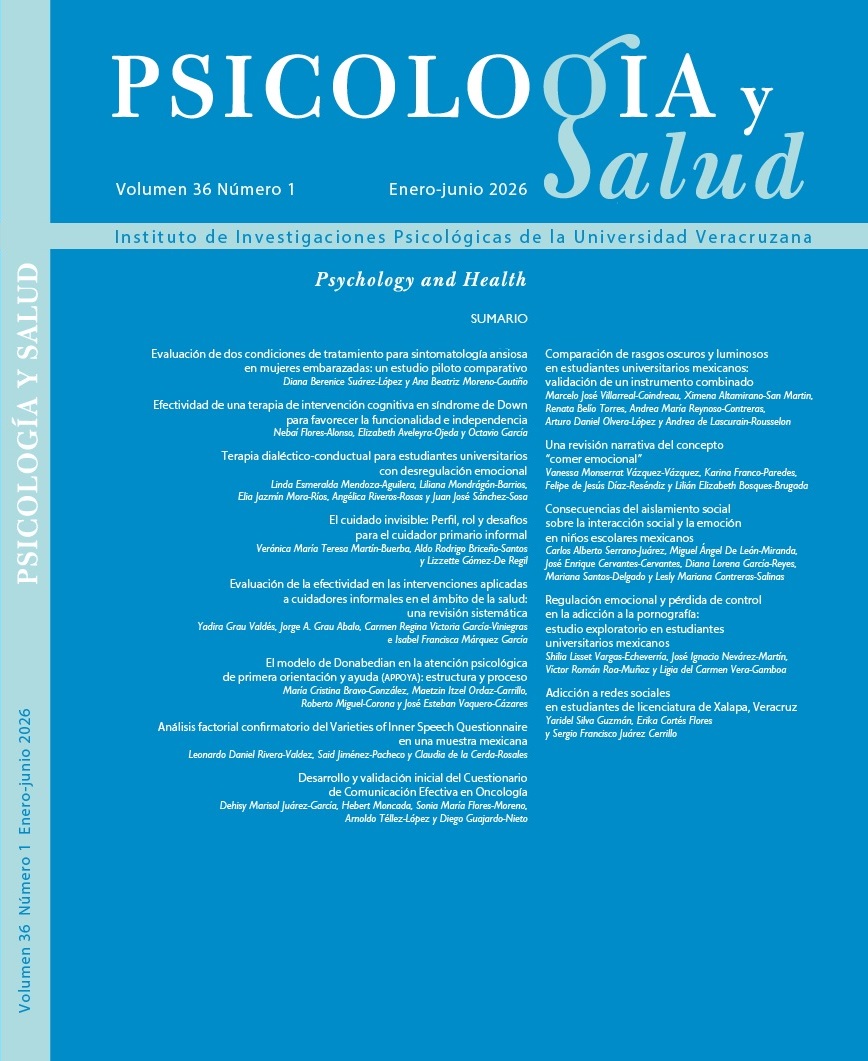
The covid-19 lockdown triggered a natural situation of isolation, which could affect children social and emotional behavior. Objective. Analyze the impact of social isolation on social interaction and emotion in Mexican participants aged 6 to 9 years. Method. This was a non-experimental study in which 44 Mexican parents and children participated and answered two socio-emotional surveys adapted online during May and June 2022. Results. The main findings showed that only children during the lockdown had higher scores of anxiety and isolation, compared to those who had siblings. Those who only lived with their mother obtained lower scores, than those who interacted with both parents in social interaction. Children who attended private schools presented more aggressive behaviors and risk of bullying. Discussion. These findings indicate that the presence of a sibling or peer and living with both parents during a period of confinement could be protective factors to reduce anxiety and have better social skills. Additionally, during the pandemic, bullying probably increased in private schools. Other authors have found that having a sibling serves as a model and catalyst for anxiety, while secure attachment with both parents benefits social interaction.
References
Almeida I., L.L., Rego, J.F., Teixeira, A.C.G. y Moreira, M.R. (2021). Social isolation and its impact on child and adolescent development: a systematic review. Revista Paulista de Pediatria, 40, e2020385. Doi: 10.1590/1984-0462/2022/40/2020385
Anccana Ll., L P., Copaja A., F.H. y Mandarachi F., R.P. (2022). Ciberbullyng en tiempos de pandemia. Ciencia Latina, 6(4), 1274-1286.
Aranda V., C.D. y Chávez M., L.E. (2017). Autoconcepto y habilidades sociales en niños como hijos únicos y niños con hermanos. PsicoEducativa: Reflexiones y Propuestas, 3(5), 38-44.
Brandt, L., Liu, S., Heim, C y Heinz, A. (2022). The effects of social isolation stress and discrimination on mental health. Translational Psychiatry, 12(1), 398. Doi: 10.1038/s41398-022-02178-4
Caballo, V.E., González, S., Alonso, V. e Irurtia, M.J. (2007). El cuestionario de interacción social para niños (CISO-N): un nuevo instrumento para la evaluación de la ansiedad social en niños. Psicología Conductual, 1, 77-93.
Cabrales A., J., Morales C., E. y Hernández G., C. (2022). Impacto de la epidemia de Covid-19 en la salud mental: panorama internacional y nacional. Psicología y Salud, 1-10. Doi: 10.25009/pys.v32i3.2797
Camacho, E., Hernández, M., Martínez L., J.M., Alcalá, I. y Sanz, A. (2022). Afectación de hábitos, relaciones, adaptación, somatización y salud mental durante la pandemia de covid-19 en México. Psicología y Salud, 55-67. Doi: 10.25009/pys.v32i3.2792
Cruz P., G., Bustamante C., J.F., Caputo, J.G., Jiménez C., M.E y Ponce de León R., S. (2020). Dispersion of a new coronavirus SARS-CoV-2 by airlines in 2020: Temporal estimates of the outbreak in Mexico. Revista de Investigación Clínica, 72(3), 138-143. Doi: 10.24875/RIC.20000113
Fancourt, D., Steptoe, A. y Bu, F. (2021). Trajectories of anxiety and depressive symptoms during enforced isolation due to COVID-19 in England: A longitudinal observational study. The Lancet. Psychiatry, 8(2), 141-149. Doi: 10.1016/S2215-0366(20)30482-X
Fernandes, C., Monteiro, L., Santos, A.J., Fernandes, M., Antunes, M., Vaughn, B.E y Veríssimo, M. (2020). Early father-child and mother-child attachment relationships: contributions to preschoolers’ social competence. Attachment & Human Development, 22(6), 687-704. Doi: 10.1080/14616734.2019.1692045
Fernández P., I., Santamaría, P., Sánchez S., F., Carrasco, M. y Del Barrio, V. (2015). Sistema de Evaluación de Niños y Adolescentes. SENA. Madrid: TEA Ediciones.
de Figueiredo, C.S., Sandre P., C., Portugal L., C.L., Mázala O., T., Da Silva C., L., Raony, Í., Ferreira E., S., Giestal A., E., Dos Santos A., A. y Bomfim P., O. (2021). Covid-19 pandemic impact on children and adolescents’ mental health: Biological, environmental, and social factors. Progress in Neuro-Psychopharmacology & Biological Psychiatry, 106, 110171. Doi: 10.1016/j.pnpbp.2020.110171
García L., G.I., Orozco V., A.E., Aguilera R., U. y Meza D., G.M. (2023). Desarrollo de habilidades sociales y cognitivas dependiendo del orden de nacimiento y número de hermanos. Alternativas en Psicología, 27(50).
Isumi, A., Doi, S., Yamaoka, Y., Takahashi, K. y Fujiwara, T. (2020). Do suicide rates in children and adolescents change during school closure in Japan? The acute effect of the first wave of COVID-19 pandemic on child and adolescent mental health. Child Abuse & Neglect, 110. Doi: 10.1016/j.chiabu.2020.104680
Lacunza A., B. y Contini de G., N. (2011). Las habilidades sociales en niños y adolescentes. Su importancia en la prevención de trastornos psicopatológicos. Fundamentos en Humanidades, 12(23), 159-182.
Loades, M.E., Chatburn, E., Higson-Sweeney, N., Reynolds, S., Shafran, R., Brigden, A., Linney, C., McManus, M.N., Borwick, C. y Crawley, E. (2020). Rapid systematic review: the impact of social isolation and loneliness on the mental health of children and adolescents in the context of covid-19. Journal of the American Academy of Child & Adolescent Psychiatry, 59(11), 1218-1239.e3. Doi: 10.1016/j.jaac.2020.05.009
Martín O., N., Saldaña L., E. y Morales S., A. (2019). Relación entre apego paterno e infantil, habilidades sociales, monoparentalidad y exclusión social. Revista de Psicología Clínica con Nños y Adolescentes, 6(2), 44-48.
Meade, J. (2021). Mental health effects of the covid-19 pandemic on children and adolescents: a review of the current research. Pediatric Clinics of North America, 68(5), 945–959. Doi: 10.1016/j.pcl.2021.05.003
Meléndez P., B. y Felipe C., E. (2024). Ansiedad en la infancia durante el confinamiento por covid-19: factores de riesgo y protección. Revista de Psicología Clínica con Niños y Adolescentes, 11(2), 2.
Merino, L y Martínez P., A. (2020). La relación entre hermanos/as y su adaptación en contextos de alto estrés familiar. Ansiedad y Estrés, 26(1), 27-32. Doi: 10.1016/j.anyes.2020.01.001
Musardo, S., Contestabile, A., Knoop, M., Baud, O. y Bellone, C. (2022). Oxytocin neurons mediate the effect of social isolation via the VTA circuits. eLife, 11, e73421. Doi: 10.7554/
Orben, A., Tomova, L. y Blakemore, S.-J. (2020). The effects of social deprivation on adolescent development and mental health. The Lancet Child & Adolescent Health, 4(8), 634-640. Doi: 10.1016/S2352-4642(20)30186-3
Panda, P.K., Gupta, J., Chowdhury, S.R., Kumar, R., Meena, A.K., Madaan, P., Sharawat, I.K. y Gulati, S. (2021). Psychological and behavioral impact of lockdown and quarantine measures for covid-19 pandemic on children, adolescents and caregivers: a systematic review and meta-analysis. Journal of Tropical Pediatrics, 67(1), fmaa122. Doi: 10.1093/tropej/fmaa122
Santoyo C., D. y Frías, S.M. (2014). Acoso escolar en México: actores involucrados y sus características. Revista Latinoamericana de Estudios Educativos, 44(4), 13-41.
Stevenson, M. y Crnic, K. (2013). Intrusive fathering, children’s self-regulation and social skills: a mediation analysis. Journal of Intellectual Disability Research, 57(6), 500-512. Doi: 10.1111/j.1365-2788.2012.01549.x
Suárez, V., Suárez Q., M., Oros R., S. y Ronquillo J., E. (2020). Epidemiología de covid-19 en México: del 27 de febrero al 30 de abril de 2020. Revista Clínica Española, 220(8), 463-471. Doi: 10.1016/j.rce.2020.05.007
Tang, S., Xiang, M., Cheung, T. y Xiangy, T. (2021). Mental health and its correlates among children and adolescents during covid-19 school closure: The importance of parent-child discussion. Journal of Affective Disorders, 279, 353-360. Doi: 10.1016/j.jad.2020.10.016
Wu, S., Yao, M., Deng, C., Marsiglia, F. F. y Duan, W. (2021). Social isolation and anxiety disorder during the covid-19 pandemic and lockdown in China. Journal of Affective Disorders, 294, 10-16. Doi: 10.1016/j.jad.2021.06.067

Esta obra está bajo una Licencia Creative Commons Atribución 4.0 Internacional.
Usted es libre de:
- Compartir: copia y redistribuye el material en cualquier medio o formato
- Adaptar: remezclar, transformar y construir sobre el material para cualquier propósito, incluso comercialmente.
El licenciante no puede revocar estas libertades siempre y cuando siga los términos de licencia.
Bajo los siguientes términos:
- Atribución — Debe dar el crédito adecuado, proporcionar un enlace a la licencia e indicar si se realizaron cambios. Usted puede hacerlo de cualquier manera razonable, pero no de ninguna manera que sugiera que el licenciante lo respalda a usted o a su uso.
- Sin restricciones adicionales — No puede aplicar términos legales o medidas tecnológicas que restrinjan legalmente a otros hacer cualquier cosa que la licencia permita.
Avisos:
- Usted no tiene que cumplir con la licencia para elementos del material en el dominio público o cuando su uso está permitido por una excepción o limitación aplicable.
- No se dan garantías. Es posible que la licencia no le dé todos los permisos necesarios para su uso previsto. Por ejemplo, otros derechos como la publicidad, la privacidad o los derechos morales pueden limitar la forma en que utiliza el material.